
How often should a defibrillator be serviced? There is no single servicing interval that applies to every AED in every setting. The correct maintenance programme depends on the manufacturer, the model, the environment in which the device is kept and how it is managed between services.
Modern defibrillators perform automatic self-tests, and routine physical checks remain essential. However, at Defib Service we also recommend planned professional defibrillator servicing at least annually for organisations that want an additional level of inspection, testing and documented maintenance evidence.
This guide explains the difference between self-tests, routine checks and professional servicing, when a defibrillator should be checked sooner, how pads and batteries fit into the maintenance schedule, and what organisations should consider when managing multiple AEDs.
How Often Should a Defibrillator Be Serviced?
The short answer is that you should always follow the maintenance instructions provided by the manufacturer of your specific defibrillator. Different AEDs have different self-test routines, battery systems, pad lifespans and maintenance requirements.
The British Heart Foundation describes modern defibrillators as low-maintenance devices and advises regular physical checks in addition to the AED’s own self-tests. Its maintenance guidance recommends checking the device regularly for its ready-status indicator, visible damage, missing accessories and pad expiry dates.
That routine checking is not the same thing as a professional service. At Defib Service, our recommendation is to use annual professional servicing as an additional layer of assurance, particularly for businesses, schools, sports clubs, universities, healthcare settings and organisations managing several defibrillators.
British Heart Foundation defibrillator maintenance guidance is a useful reference for routine owner checks, while the manufacturer’s own manual should remain the primary source for model-specific maintenance requirements.
THE SIMPLE ANSWER
Follow the manufacturer’s instructions, carry out regular routine checks, and consider planned annual professional servicing where documented inspection and testing are important to your organisation.
If the AED shows a warning, has been used, is damaged or there is any concern about its condition, do not wait for the next scheduled service.
Self-Tests, Routine Checks and Professional Servicing Are Different
A common source of confusion is that the words check, maintenance and service are often used as though they mean the same thing. In practice, they perform different roles.
An AED’s automatic self-test is built into the device. Routine checks are carried out by the owner or guardian. Professional servicing provides a more detailed independent inspection and testing process. These layers should complement one another rather than compete with one another.
1. AED SELF-TEST
The defibrillator automatically monitors the functions its manufacturer has designed it to check. A ready indicator, green light or similar display usually shows the device has completed those internal checks without detecting a fault.
2. ROUTINE CHECKS
The organisation checks that the AED is present, accessible and showing the expected ready status, with pads, batteries and accessories available and in suitable condition.
3. PROFESSIONAL SERVICE
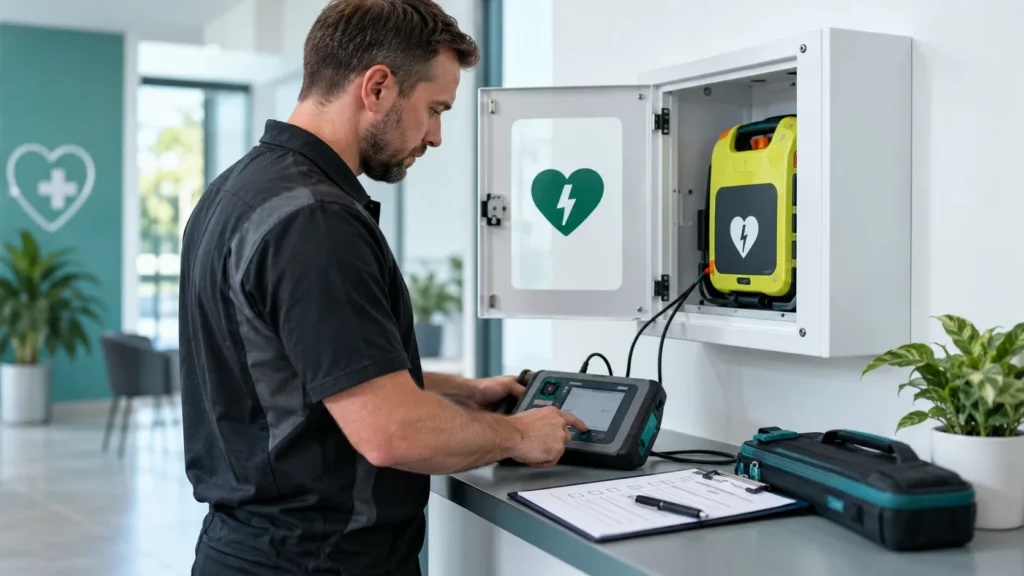
A technician carries out additional inspection and testing and provides a documented service record. This can help organisations demonstrate how their emergency equipment is being actively maintained.
How Often Should You Carry Out Routine Defibrillator Checks?
Routine checks should be carried out at the frequency recommended by the manufacturer. The British Heart Foundation advises regular physical checks and its current maintenance guidance recommends weekly checking of the AED in addition to the automatic self-tests performed by the device.
In practical terms, a routine check should confirm that the defibrillator is still where it should be, can be accessed quickly, is showing its normal ready indication and has not been visibly damaged or used. Pads should be in date and the battery should be managed in accordance with the instructions for that model.
Organisations should also decide who is responsible for carrying out the check. A simple maintenance log can prevent the common situation where everyone assumes somebody else is looking after the AED.
Why We Recommend Annual Professional Defibrillator Servicing
There is an important distinction between a universal requirement and a professional recommendation. Not every manufacturer states that an AED must receive a chargeable annual service, and some public guidance emphasises that modern defibrillators are designed to be relatively low maintenance.
Our recommendation at Defib Service is nevertheless to have organisational AEDs professionally serviced at least annually where the owner wants an independent inspection, functional testing and a documented maintenance history.
This is particularly valuable when the defibrillator forms part of a wider health and safety system, is located in a high-footfall environment, is spread across several sites, or needs to be managed by facilities, medical, governance or compliance teams.
Annual servicing creates a consistent point in the year to review the device, its accessories and its consumables rather than relying solely on individual self-tests and informal checks.
When Should a Defibrillator Be Checked or Serviced Sooner?
You should not wait for the next planned service if something has changed. Some situations justify immediate attention regardless of when the AED was last inspected.
The AED displays a warning or fault
A red indicator, warning message, audible alert or failed self-test should be investigated promptly in line with the manufacturer's instructions.
The defibrillator has been used
After an emergency use, pads will normally need replacing and the device should be checked and returned to readiness before being placed back into service.
There is visible damage or contamination
Damage to the device, carry case, cabinet, pads, cables or other accessories should not simply be left until the next scheduled maintenance visit.
Pads or batteries are due or overdue
Expired or depleted consumables need to be replaced in accordance with the requirements of the particular AED model.
How Often Do Defibrillator Pads and Batteries Need Replacing?
Electrode pads and batteries have their own replacement schedules, and these vary considerably between manufacturers and models.
Defibrillator pads have expiry dates and should be replaced before they become out of date. They also normally need replacing after use. Battery arrangements vary: some AEDs use a replaceable battery with a stated standby life, while others have different battery-status systems or replacement intervals.
The British Heart Foundation notes that pad and battery lifespan varies by make and model, which is why organisations should avoid applying one generic schedule to every AED they own.
For multi-device estates, recording pad expiry dates and expected battery replacement dates centrally can make this much easier to manage. It also allows replacement consumables to be ordered before the device reaches a point where it is no longer fully ready for use.
Is an AED Self-Test Enough?
Automatic self-tests are an important safety feature, but we do not recommend treating them as the organisation’s only maintenance measure.
A self-test can only assess the components and functions the manufacturer has designed that model to monitor. It cannot replace a physical inspection of the device, its location and its accessories, and it does not provide the same independent maintenance record as a professional service.
A green status indicator is therefore useful information, but it should sit alongside routine physical checks and an appropriate maintenance programme rather than replace them.
A GREEN LIGHT IS NOT THE WHOLE MAINTENANCE PROGRAMME
Use the AED’s status indicator as one layer of assurance. Combine it with routine physical checks, consumable tracking and an appropriate servicing programme for your organisation.
What Should a Professional Defibrillator Service Include?
The exact service procedure should reflect the manufacturer and model. At Defib Service, our Rescue Ready approach is designed to provide a more comprehensive assessment than a basic visual check.
Depending on the AED and its capabilities, this can include a live VF/VT shock test, paediatric shock testing where applicable, shock output verification against manufacturer recommendations with Joules recorded, NSR non-shock testing, battery and electrode pad inspection, functionality testing, calibration, visual inspection for damage or missing items, and software updates or fault-code resets where supported.
Each AED receives its own detailed service report so the organisation has a documented record relating to the specific device inspected.
You can read more about our professional defibrillator servicing and what is included in our service.
Why Service Documentation Matters
For an organisation with one AED, a simple maintenance record may be enough to keep track of routine checks and consumable dates. As the number of devices grows, documentation becomes increasingly important.
Individual reports help identify which defibrillator was serviced, what was checked, the results recorded, any faults or recommendations identified and when pads or batteries may require attention.
This can be particularly useful for facilities teams, schools and academy trusts, universities, sports organisations, councils, healthcare providers and multi-site businesses. It creates a clear maintenance history rather than relying on memory or a collection of unrelated emails and spreadsheets.
Documentation should be treated as supporting evidence of an active maintenance programme rather than a claim that a service report alone proves compliance with every possible regulation or policy.
Managing Multiple Defibrillators Across Different Sites
Managing one AED is relatively simple. Managing ten, twenty or more devices across different locations creates a different challenge.
Different models may use different pads and batteries, have different expiry dates and follow different manufacturer instructions. Devices can also move between buildings or departments, which makes accurate records important.
A planned servicing programme can bring those devices into one organised schedule. At Defib Service, we can support multi-site estates with individual service reporting, pad and battery expiry tracking, replacement reminders and advice where older or additional equipment needs to be considered.
The objective is not simply to service each AED in isolation, but to help the organisation maintain visibility of the entire defibrillator estate.
Defibrillator Servicing FAQs
Defib Service recommends planned annual professional servicing as an additional layer of inspection, testing and documentation for organisations that want that level of assurance.
Follow the manufacturer’s instructions for your model. The British Heart Foundation recommends regular physical checks and its maintenance guidance advises weekly checks alongside the AED’s automatic self-tests.
Investigate the warning promptly using the manufacturer guidance for that device. Do not wait until the next planned annual service if the AED is reporting a fault or abnormal status.
Yes. Electrode pads have expiry dates and should be replaced before they become out of date. They also normally require replacement after use.
Battery lifespan varies by manufacturer, model, usage and self-test routine. Follow the instructions for the specific AED rather than assuming one replacement interval applies to every device.
Yes. We support organisations with multiple defibrillators and locations, including individual service reports, consumable expiry tracking, replacement reminders and coordinated servicing programmes.
PROFESSIONAL DEFIBRILLATOR SERVICING
Need Help Keeping Your Defibrillators Rescue Ready?
If you manage a single AED or a larger estate across multiple sites, we can help with professional servicing, individual service reports, pad and battery expiry tracking and ongoing equipment support.
Our servicing is available nationwide and can be tailored around the size and requirements of your organisation.
Nationwide Servicing • Individual Service Reports • Multi-Site AED Management