
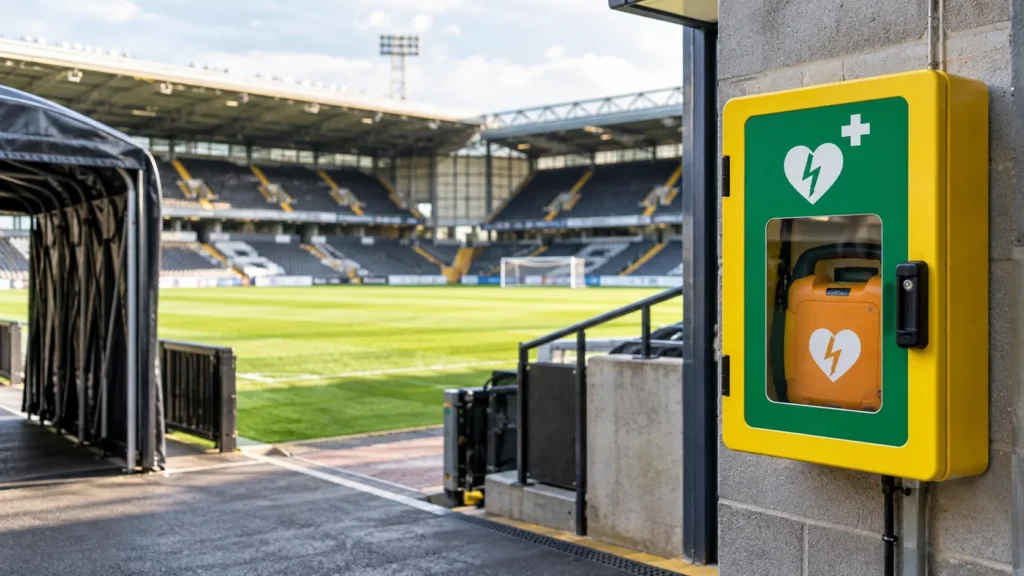
EFL football club defibrillator servicing is about much more than checking that a defibrillator has a green light. For clubs in the Championship, League One and League Two, defibrillators form part of a much wider medical, stadium and matchday emergency-care environment where equipment needs to be accessible, maintained, documented and ready for use.
EFL clubs may operate defibrillators across first-team stadiums, training grounds, Academies, offices, hospitality areas and community facilities. Some estates contain several different defibrillator models, each with different pads, batteries, expiry dates and manufacturer instructions. Defib Service supports professional football clubs with servicing, testing, reporting and ongoing defibrillator management across the UK.
This guide explains how professional defibrillator servicing can fit into an EFL club’s wider medical and facilities programme, what routine checks should cover, why individual service records matter, how multi-site estates can be managed more effectively, and how the position changes further down the football pyramid at Steps 1–6 of the National League System.
Why Defibrillator Management Matters for EFL Clubs
Championship, League One and League Two clubs operate in a professional football environment where player welfare, matchday medical provision and emergency planning are taken seriously.
The EFL Regulations contain detailed medical provisions around team doctors, therapists, pitch-side care, emergency action planning and crowd safety. Championship clubs, for example, are required to have a fully equipped dedicated ambulance available during League matches, while clubs are expected to maintain appropriate emergency arrangements and medical personnel. Current EFL Regulations should always be checked for the requirements applicable to the club and competition.
Although the EFL Handbook does not set out a simple universal rule saying every defibrillator must receive an annual third-party service, that does not make defibrillator management a minor issue. Where a defibrillator forms part of a club’s emergency response arrangements, the club still needs confidence that the device is accessible, its consumables are in date, faults are acted upon and its maintenance history can be demonstrated.
COMPLIANCE IS EASIER TO DEMONSTRATE WHEN IT'S DOCUMENTED
A green status indicator is useful, but it is not the same as having a documented maintenance programme.
For professional football clubs, clear records make it easier to demonstrate that each defibrillator has been actively managed. That can include routine check records, individual service reports, test results, pad and battery status, faults identified, recommendations made and evidence that actions have been completed.
That gives medical, facilities, health and safety and governance teams a clearer audit trail showing how the club’s emergency equipment is being maintained over time.
What Should EFL Clubs Check Between Professional Services?
Routine checks remain one of the most important parts of defibrillator management. Modern defibrillators perform automatic self-tests, but clubs should not rely on those self-tests alone.
Staff should regularly confirm that each defibrillator is present in its designated location, accessible, showing the expected ready-status indication and free from obvious damage. Electrode pads should be in date, batteries should be managed in accordance with the manufacturer’s instructions and any missing accessories should be replaced.
For a professional club, responsibility should also be clear. Whether checks sit with the medical department, facilities team, health and safety lead or another nominated person, someone should own the process and maintain a record of it.
1. DEFIBRILLATOR SELF-TEST
The device automatically checks the internal functions designed into that model and indicates whether it has detected a problem.
2. CLUB CHECK
Staff confirm location, accessibility, ready status, pad and battery condition, accessories and any visible damage.
3. PROFESSIONAL SERVICE
Additional inspection, testing, calibration where applicable and a documented service record provide a further layer of assurance.
Why We Recommend Annual Professional Defibrillator Servicing for EFL Clubs
There is an important difference between a regulatory requirement and our professional recommendation. Not every defibrillator manufacturer specifies an annual service, and the exact maintenance instructions vary between models.
At Defib Service, however, we strongly recommend professional servicing at least annually for EFL club defibrillators, alongside the device’s own automatic self-tests and the club’s routine checks.
For a professional football club, an annual service provides a consistent point in the year to inspect and test each device, review consumable dates, identify damage or faults, check accessories and create an up-to-date maintenance record for the individual defibrillator. Many clubs may find it practical to align this with pre-season planning so faults, expiring consumables and replacement needs can be dealt with before competitive fixtures begin.
This can be particularly useful where the club needs to demonstrate to medical, facilities, health and safety, governance or senior management teams that its emergency equipment is being actively maintained rather than simply left in place until a fault appears.
OUR RECOMMENDATION FOR EFL CLUBS
Professional service at least annually, supported by regular club checks and the defibrillator’s automatic self-tests.
If a device shows a warning, has been used, is damaged or there is any concern about its condition, the club should act immediately rather than waiting for the next planned service.
What Can a Professional Football Club Defibrillator Service Include?
The precise procedure depends on the manufacturer and model, but professional servicing should go beyond a basic visual glance.
Our Rescue Ready servicing can include physical inspection, live VF/VT shock testing, NSR non-shock testing, shock-output verification with Joules recorded against manufacturer expectations, paediatric shock testing where applicable, battery and electrode-pad inspection, functionality checks, calibration where appropriate, software updates or fault-code resets where supported, and inspection of associated accessories.
Each defibrillator we service receives its own individual service report, giving the club a documented record of the checks and test results relating to that specific device.
You can read more about our football club defibrillator servicing and the testing included in our Rescue Ready service.
What Should an EFL Club Be Able to Evidence?
For an EFL club, good defibrillator management should leave a clear evidence trail rather than relying on a single generic certificate or an informal spreadsheet.
A club should be able to identify each defibrillator and show when it was serviced, what was inspected or tested, the results recorded, the condition and expiry status of pads and batteries, any faults found, recommendations made and whether required actions were completed. Individual service reports make that evidence much easier to maintain for every device.
It also helps when equipment responsibility is shared across departments. Medical staff may need assurance around matchday and training provision, while facilities teams may be responsible for cabinets, access and replacement consumables. Clear device-level records help those functions work from the same information.
Managing Defibrillators Across Stadiums, Training Grounds and Academies
One of the biggest differences between professional football and smaller clubs is the scale of the estate.
An EFL club may have defibrillators in the stadium, first-team training ground, Academy, offices, hospitality areas, gyms, community facilities and public-access locations. Different areas may also contain different defibrillator models acquired at different times.
A coordinated servicing programme can bring all of those devices into one maintenance schedule. Rather than each unit being managed independently, the club can maintain a central view of location, model, serial number, last service date, pad expiry, battery information, faults and outstanding actions.
For multi-site clubs, we can also support pad and battery expiry tracking and provide reminders ahead of replacement dates, making it easier to plan consumables before they become urgent.
Matchday Readiness: What If a Defibrillator Is Used or Develops a Fault?
A defibrillator should not remain in service unchanged after an emergency use or when it is displaying a warning.
After use, electrode pads will normally require replacement and the device should be checked before being returned to readiness. If a defibrillator develops a manufacturer-warranty fault, Defib Service can also help coordinate communication with the manufacturer or authorised repair route and support the club through repair or replacement.
Where a unit needs to be away for repair, a temporary loan defibrillator may be available depending on the circumstances and requirements. This can reduce the risk of leaving an important location without cover while the original device is being resolved.
Pad and Battery Expiry Tracking for EFL Clubs
Electrode pads expire, and battery arrangements vary between defibrillator models. For a club with several devices, these dates can quickly become difficult to manage if they are not recorded centrally.
Professional servicing provides an opportunity to review the consumables fitted to each defibrillator and identify which items are due before the next planned visit. A good system should make it clear which device requires which pads or battery and when replacement should be arranged.
This is particularly valuable for mixed estates, where one club may have several defibrillator brands or generations of equipment in use at the same time.
Defibrillator Supply, Replacement and Estate Advice for EFL Clubs
Age alone does not automatically mean a defibrillator needs replacing. Many defibrillators remain serviceable for years when properly supported and maintained.
Replacement becomes more important where a model has been discontinued, consumables are becoming difficult to source, manufacturer support has ended, a fault is uneconomical to repair, or the device no longer suits the club’s operational requirements.
For professional clubs, replacement planning is often better handled strategically rather than reactively. Reviewing the estate during servicing allows older units to be identified early so budgets and replacement priorities can be planned rather than waiting for an unexpected failure.
Where additional or replacement defibrillators are required, Defib Service can advise on suitable models and supply equipment directly. Rather than pushing one device for every club, we can look at the intended location, likely users, paediatric requirements, consumable costs, manufacturer support and how the new defibrillator will fit into the club’s existing estate. This can also help clubs standardise models over time where that makes operational and financial sense.
Defibrillator Requirements for National League System Clubs at Steps 1–6
The position further down the football pyramid is also important.
Current FA medical guidance states that facilities at Steps 1–6 of the National League System must have access to an Automated External Defibrillator on site, with clubs also advised to follow manufacturer guidance for the maintenance and servicing of medical equipment.
That means the defibrillator requirement extends well beyond the professional EFL. National League System clubs may have smaller budgets and fewer staff, but where a defibrillator is provided it still needs to be accessible, checked and maintained appropriately.
For clubs at Steps 1–6, the most proportionate arrangement may depend on the size of the club, number of defibrillators, manufacturer guidance and available resources. Our annual professional servicing recommendation remains the same, but the wider programme can be tailored around the actual estate rather than assuming every club needs the same level of support as a Championship organisation.
FA STEPS 1–6
Facilities at Steps 1–6 must have access to a defibrillator on site.
Clubs should also follow manufacturer guidance for the maintenance and servicing of their medical equipment and check any additional league or competition requirements that apply.
A Practical Defibrillator Maintenance Framework for Football Clubs
Whether the club is in the Championship or Step 6, the underlying maintenance principles are similar. The scale and level of support may differ, but the defibrillator still needs an organised system around it.
Confirm every defibrillator location
Maintain an up-to-date list of stadium, training-ground, Academy and other defibrillator locations.
Carry out routine ready-status checks
Check accessibility, status indicators, visible condition, accessories and any obvious signs of use or damage.
Track pads and batteries
Record expiry and replacement information for the consumables fitted to each individual device.
Arrange planned professional servicing
Defib Service recommends professional servicing at least annually alongside routine checks and self-tests.
Keep individual service records
Retain device-specific documentation showing what was inspected, tested and identified at each service.
Act on faults immediately
Warnings, emergency use, damage or overdue consumables should be addressed rather than left until the next annual visit.
EFL Football Club Defibrillator Servicing FAQs
There is not one universal annual third-party servicing rule that applies to every defibrillator model. Clubs should follow manufacturer instructions and all applicable EFL, FA, safety-certificate and competition requirements. Defib Service recommends professional servicing at least annually as an additional layer of inspection, testing and documentation.
Yes. The primary focus of this guide is the EFL: Championship, League One and League Two clubs, including stadium, training-ground, Academy and multi-site defibrillator management.
Current FA medical guidance states that facilities at Steps 1–6 of the National League System must have access to a defibrillator on site. Clubs should also follow manufacturer guidance for maintenance and servicing and check any additional league requirements.
A ready-status indicator is important, but it should not be treated as the whole maintenance programme. Routine physical checks, consumable management and an appropriate servicing plan provide additional assurance.
Yes. We can support clubs with defibrillators across stadiums, training grounds, Academies and other facilities, including individual service reports, consumable expiry tracking, replacement reminders and coordinated servicing.
If a serviced defibrillator develops a manufacturer-warranty fault, we can help coordinate the manufacturer or authorised repair process and support repair or replacement. Temporary loan equipment may also be available depending on the circumstances.
DEFIBRILLATOR SUPPORT FOR FOOTBALL CLUBS
Need Help Managing Your Club's Defibrillators?
From Championship and EFL estates to National League System clubs, we can help keep your defibrillators professionally serviced, documented and easier to manage.
Our support can include annual servicing, individual defibrillator reports, pad and battery expiry tracking, fault support, replacement planning, advice on suitable models and direct supply of additional or replacement defibrillators.
Nationwide Servicing • Individual Service Reports • Multi-Site Defibrillator Management