
Football club defibrillator requirements have developed significantly as AEDs have become an increasingly important part of emergency medical provision across the game, from grassroots facilities and non-league clubs through to professional football clubs and Academies.
But simply having a defibrillator on site is only part of the picture. Clubs also need to consider whether their AEDs are accessible, properly maintained, within their consumable expiry dates and ready for use should a sudden cardiac arrest occur.
Requirements can vary depending on the level of football, competition, venue and Academy status. In this guide, we explain the current football defibrillator requirements, what routine AED checks should involve, the difference between an AED’s automatic self-test and professional servicing, and why maintaining clear service documentation can be particularly important for football clubs.
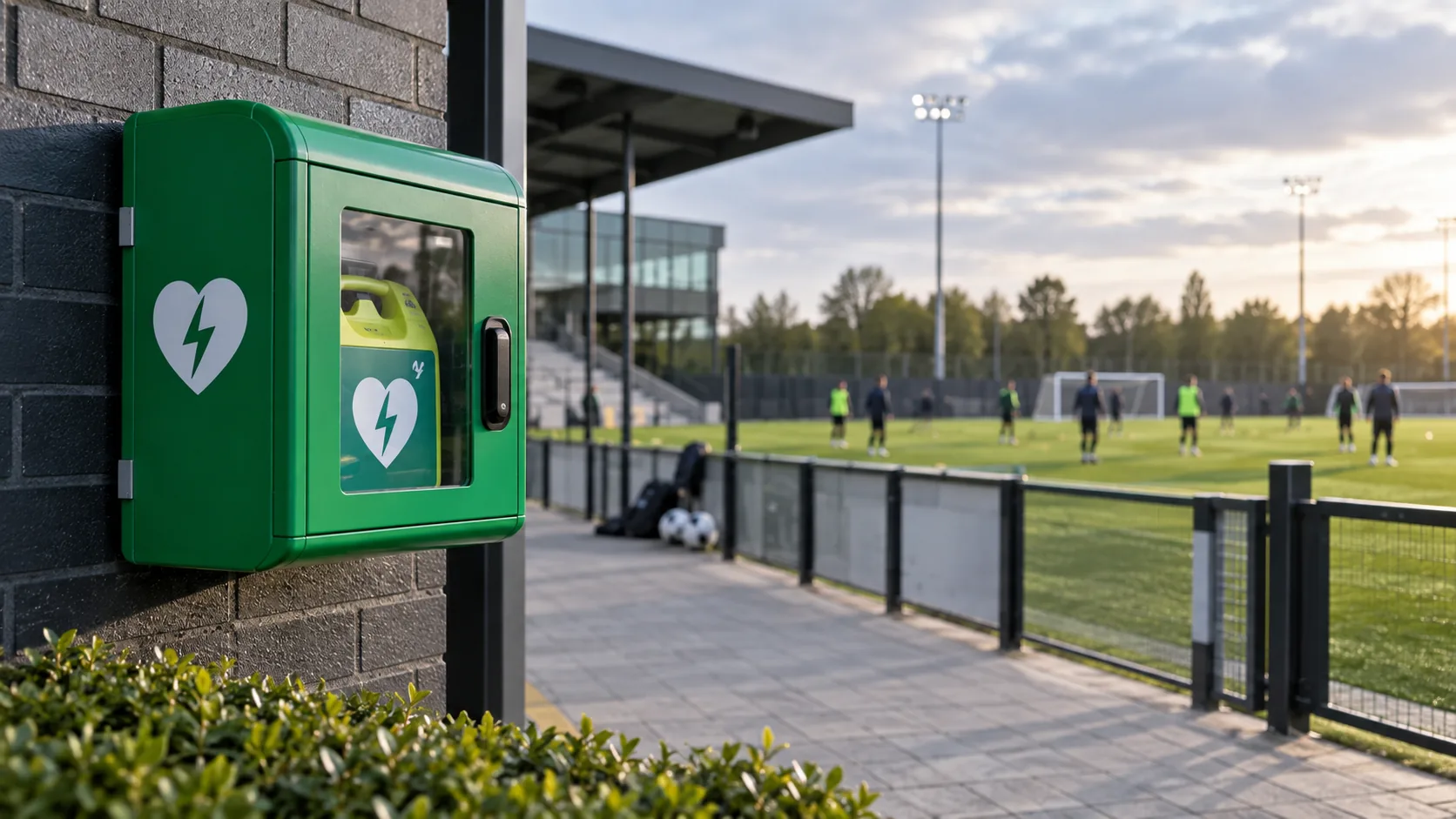
Football Club Defibrillator Requirements: Do Clubs Need an AED?
The requirements for defibrillator provision in football depend on the level of the club, competition, venue and, where applicable, Academy status. There isn’t one single rule that applies identically to every football club in the UK.
However, defibrillators are now an established part of emergency medical provision throughout the football pyramid, and specific requirements apply at certain levels of the game.
For example, FA medical guidance requires facilities at Steps 1–6 of the National League System to have access to an AED on site. Premier League Youth Development Rules also require Academies to ensure that a defibrillator and trauma equipment are maintained and accessible at venues where matches are played and coaching takes place.
Even where a particular competition does not impose the same requirements, clubs that provide an AED should have appropriate arrangements in place to make sure it remains accessible, maintained and ready for use.
What Are the FA Defibrillator Requirements for Football Clubs?
The Football Association’s requirements vary depending on the level of the football pyramid and the facilities being used.
Current FA medical guidance states that facilities at Steps 1–6 of the National League System must have access to an Automated External Defibrillator (AED) on site. The FA also advises clubs to follow the manufacturer’s guidelines for the maintenance and servicing of medical equipment.
This is an important distinction. Providing an AED is not simply a case of purchasing a device and leaving it in place indefinitely. Once a defibrillator forms part of a club’s emergency medical provision, the club needs an appropriate system for checking and maintaining that equipment.
Depending on the club and competition, additional medical and ground requirements may also apply. Clubs should therefore always check the current requirements applicable to their particular league, competition and facilities.
FA GUIDANCE
Have an AED on site — and have a plan for maintaining it.
FA medical guidance requires AED provision at facilities across Steps 1–6 and advises clubs to follow manufacturer guidance for maintenance and servicing.
What Are the Premier League Academy Defibrillator Requirements?
Premier League Academies have more specific requirements around defibrillator provision.
The Premier League Youth Development Rules require Academies to ensure that a defibrillator and trauma equipment are maintained and accessible at each venue where matches are played and coaching takes place.
The accompanying guidance also states that somebody present at all games should know how to use a defibrillator.
For an Academy operating across a stadium, training ground and multiple coaching or match venues, this makes effective AED management particularly important. Clubs need visibility of where their devices are located, whether they remain operational and accessible, and when pads, batteries or other consumables require attention.
It is also important to distinguish the wording of the rule from our own servicing recommendation. The Premier League requires the equipment to be maintained and accessible; it does not, in that wording, prescribe a specific annual professional servicing interval.
At Defib Service, however, we strongly recommend planned professional servicing of club and Academy AEDs, particularly where the organisation needs documented evidence that its equipment is being actively maintained.
My AED Self-Tests — So Why Does It Need Servicing?
Modern defibrillators are designed to perform automatic self-tests, and these are an important part of monitoring the condition of the device.
A successful self-test or green status indicator provides useful reassurance that the AED has completed the internal checks built into that particular model.
However, a successful self-test is not the same as a professional service.
An AED can only self-test the components and functions the manufacturer has designed it to monitor. It cannot physically inspect itself for damage, assess how the equipment has been stored, check the condition of accessories in the same way a technician can, or provide an independent maintenance record for your club.
Professional servicing can go further by using appropriate test equipment to assess the operation of the AED, alongside a physical inspection of the device and accessories, consumable expiry checks and documented test results.
From our own servicing experience, we have seen why relying solely on the device’s own status indicator is not enough. A green light should not be treated as absolute proof that every aspect of the AED and its associated equipment is ready for an emergency situation.
That is why we recommend treating automatic self-tests as one layer of AED assurance, rather than the club’s only maintenance measure.
A GREEN LIGHT ISN'T A MAINTENANCE RECORD
An AED’s self-test is an important safety feature, but it should not be relied upon as the sole method of confirming that the equipment is being properly maintained.
Planned professional servicing provides additional inspection and testing, together with documented evidence of the condition of the device, consumables and any actions or recommendations identified.
The Three Layers of AED Maintenance
Keeping a football club’s defibrillators ready for use shouldn’t depend on a single check. We recommend thinking about AED maintenance in three layers, with each performing a different role.
1. AED SELF-TEST
The AED performs its own automated internal checks and displays a status indicator to show whether it has detected a problem.
Important — but not a complete maintenance programme.
2. ROUTINE AED CHECKS
Club staff should regularly check that the AED is present, accessible and showing the expected ready status, with pads, batteries and accessories available and within their expiry dates.
Any visible damage, missing equipment or warning indicators should be acted upon promptly.
3. PROFESSIONAL SERVICING
A planned professional service provides a more comprehensive inspection and testing of the AED and its associated equipment, with the results documented for the club.
This provides an additional level of assurance alongside the AED’s self-tests and your club’s routine checks.
These layers complement rather than replace one another. Routine checks help identify obvious day-to-day issues, automatic self-tests provide ongoing internal monitoring, and professional servicing provides additional inspection, testing and documented evidence of the maintenance undertaken.
Football Club Defibrillator Maintenance Checklist
A simple maintenance programme can help clubs keep their defibrillators accessible, maintained and ready for use. The exact requirements will depend on the device manufacturer and the club’s circumstances, but the following provides a useful framework.
Check the defibrillator is present and accessible
Make sure each device remains in its designated location and can be reached quickly in an emergency.
Check the ready-status indicator
Look for the normal ready indication and investigate any warning, error or fault displayed by the defibrillator.
Inspect the equipment and accessories
Look for visible damage, contamination, missing accessories or anything else that could affect emergency use.
Monitor electrode pad expiry dates
Record expiry dates and arrange replacements before pads become out of date.
Monitor batteries
Follow the manufacturer's guidance for battery condition, replacement and expiry dates where applicable.
Check cabinets and storage locations
Make sure cabinets are accessible, operational and haven't been damaged or obstructed.
Record routine checks
Keeping a simple record provides evidence that the club is actively monitoring its emergency equipment between professional services.
Arrange planned professional servicing
Defib Service recommends at least annual professional servicing, alongside the device's automatic self-tests and the club's own routine checks.
Keep individual service documentation
Retain servicing reports so the club has a documented maintenance history for each defibrillator.
Track faults and outstanding actions
If a fault, expired consumable or other issue is identified, record it and make sure the required action is completed rather than simply waiting for the next scheduled check.
THE SIMPLE PRINCIPLE
Self-test. Routine check. Professional service. Document.
Each plays a different role. Together they provide a much stronger approach to managing a club’s defibrillators than relying on the device’s automatic self-test alone.
Remember: a routine visual check is not the same as a professional service. Its purpose is to identify obvious problems between services and help ensure that changes in the condition or availability of the AED are noticed promptly.
For clubs where maintaining clear compliance and maintenance documentation is particularly important, planned annual servicing also provides a consistent documented record for each defibrillator in the estate.
For clubs with governance, health & safety, medical or competition requirements to consider, maintaining an organised service history provides valuable supporting evidence.
Why Defibrillator Service Documentation Matters for Football Clubs
Having a defibrillator on site is important, but clubs may also need to be able to demonstrate how that equipment is being managed and maintained.
A green status indicator tells you what the AED is reporting at that point in time. It doesn’t provide the same evidence as a documented maintenance history showing when the device was professionally inspected and tested, what was checked, the results recorded and whether any issues were identified.
This becomes particularly valuable for football clubs managing multiple AEDs across a stadium, training ground, Academy and other facilities. Without individual records, it can become difficult to keep track of which devices have been serviced, when consumables expire and whether outstanding actions have been completed.
At Defib Service, each AED we service receives its own individual service report, providing the club with a documented record of the inspection and testing carried out.
Individual AED identification
A clear record relating the report to the specific defibrillator serviced.
Inspection and test results
Documentation of the checks and applicable tests completed during the service.
Pad and battery information
Expiry dates and condition recorded to help clubs plan replacement consumables.
Faults and recommendations
Any issues identified can be documented together with recommended actions.
Maintenance history
Reports can be retained by the club as evidence of its ongoing AED maintenance programme.
COMPLIANCE IS EASIER TO DEMONSTRATE WHEN IT'S DOCUMENTED
A defibrillator may show that it considers itself ready, but when a club needs to demonstrate how its AED equipment is being maintained, documented inspection and test records provide something a status indicator cannot.
For clubs with governance, health & safety, medical or competition requirements to consider, maintaining an organised service history provides valuable supporting evidence.
How Often Should a Football Club Defibrillator Be Serviced?
There isn’t a single servicing interval that applies to every defibrillator at every football club. Clubs should always follow the maintenance instructions provided by the AED manufacturer and any requirements that apply to their league, competition or facilities.
However, at Defib Service, we strongly recommend planned annual professional servicing for football club AEDs.
An annual service provides a regular opportunity to professionally inspect and test the equipment, review the condition and expiry dates of pads and batteries, identify issues that may not be apparent during routine club checks, and create an up-to-date documented maintenance record for each device.
This is particularly valuable for clubs managing AEDs across multiple locations, where relying solely on individual devices to self-test can make it difficult to maintain oversight of the wider defibrillator estate.
Professional servicing should also work alongside — rather than replace — the club’s routine AED checks. If an AED displays a warning, is damaged, has been used in an emergency or there is any concern about its condition, the club should act on this immediately rather than waiting for the next scheduled service.
OUR RECOMMENDATION
Have your football club’s AEDs professionally serviced at least annually, alongside regular routine checks and the automatic self-tests performed by the devices themselves.
For clubs where maintaining clear compliance and maintenance documentation is particularly important, planned annual servicing also provides a consistent documented record for each AED in the estate.
For clubs with governance, health & safety, medical or competition requirements to consider, maintaining an organised service history provides valuable supporting evidence.
The appropriate servicing programme may also depend on the environment, frequency of use, manufacturer recommendations and the needs of the organisation. Higher-use or particularly critical locations may justify additional checks or support.
Managing Multiple AEDs Across a Football Club or Academy
For clubs with a single defibrillator, keeping track of servicing and consumable expiry dates can be relatively straightforward. For professional clubs and Academies with AEDs distributed across multiple facilities, the challenge can be very different.
Defibrillators may be located throughout a stadium, training ground, Academy, offices and other club facilities. Different AED models may also use different batteries and electrode pads, each with their own replacement dates and maintenance requirements.
Effective AED estate management means having a clear picture of what equipment you have, where it is located, when it was last serviced and when its consumables require attention.
A planned multi-site servicing programme can bring those individual devices together into one organised maintenance schedule, helping the club maintain oversight of its entire AED estate rather than managing each defibrillator in isolation.
Centralised AED records
Maintain visibility of the defibrillators across your club's facilities.
Individual device reporting
Keep a separate servicing record for each AED within the estate.
Pad and battery expiry tracking
Monitor consumable expiry dates so replacements can be planned before they become due.
Multiple locations coordinated together
Stadium, training ground, Academy and other club facilities can form part of the same servicing programme.
Different AED models managed together
A mixed estate doesn't necessarily need to be replaced simply to standardise equipment; different devices can be recorded and managed appropriately.
For larger clubs, this approach can also make budgeting easier. Rather than discovering expired consumables or ageing devices unexpectedly, the club can build a clearer picture of upcoming servicing, replacement consumables and potential equipment replacement requirements.
When Should a Football Club Replace a Defibrillator?
Defibrillators are designed to provide many years of service, so the age of an AED alone does not necessarily mean that it needs to be replaced.
However, clubs should consider the wider lifecycle of the device. As AED models become older, manufacturers may discontinue them, replacement pads or batteries may become harder to obtain, software or technical support may end, and repairs may no longer be commercially viable.
Replacement should therefore be considered when an AED has reached the end of manufacturer support, essential consumables are becoming unavailable, the device develops a fault that cannot be economically repaired, or the equipment no longer meets the operational requirements of the club.
This is particularly important with older or discontinued models. A defibrillator may still appear operational today, but if its pads expire, its battery reaches the end of its service life or the device subsequently develops a fault, maintaining that AED may become increasingly difficult.
That doesn’t necessarily mean an older AED needs to be removed from service immediately. Where the device remains operational, supported and its required consumables remain available, the appropriate approach may be to continue maintaining it while planning for replacement in a controlled way.
What About Discontinued AEDs?
When a manufacturer discontinues an AED model, clubs should establish whether replacement pads and batteries remain available, how long manufacturer support is expected to continue and what would happen if the device developed a fault.
The Physio-Control LIFEPAK CR Plus is a good example of why this matters. Although many of these devices remain in use, the model has been discontinued and clubs operating older units should understand the availability of consumables and support when planning the future of their AED estate.
Signs It May Be Time to Consider Replacement
The manufacturer has discontinued the AED
This doesn't automatically make the device unusable, but future support and consumable availability should be considered.
Replacement pads or batteries are becoming difficult to obtain
An AED cannot remain operational indefinitely if essential consumables can no longer be sourced.
The AED develops a fault
Depending on its age and support status, repair may not be possible or commercially sensible.
The club's requirements have changed
You may need additional functionality, paediatric capability or a device better suited to its location and intended users.
You are standardising or expanding your AED estate
Replacing selected older devices can sometimes make ongoing consumable management, staff familiarity and estate maintenance simpler.
A planned replacement strategy allows clubs to budget for ageing equipment rather than waiting until an AED unexpectedly reaches the point where it can no longer be supported.
Choosing Additional or Replacement AEDs for a Football Club
Whether a club is replacing an ageing defibrillator, expanding AED provision or adding cover at a new facility, choosing the right device involves more than simply comparing prices.
There isn’t necessarily one “best” defibrillator for every football club. The most appropriate AED will depend on where it will be located, who may need to use it, the environment in which it will be stored and how it fits alongside the club’s existing equipment.
At Defib Service, we prefer to understand those requirements before recommending a particular model. This helps clubs select equipment that is appropriate for its intended use while also considering the longer-term practicalities of maintaining the wider AED estate.
What Should Clubs Consider When Choosing an AED?
Where the AED will be located
A stadium, training ground, Academy building or outdoor facility may each have different practical requirements.
Who is likely to use it
Consider whether the AED may be used by trained medical staff, other club employees or members of the public.
Adult and paediatric requirements
If the AED could be required for both adults and children, the club should consider how that particular device provides paediatric functionality.
The existing AED estate
Where practical, choosing equipment that complements existing devices can make staff familiarity, consumable management and ongoing maintenance simpler.
Consumable availability and ongoing costs
The purchase price isn't the only consideration. Pad and battery replacement intervals, availability and ongoing costs should form part of the decision.
Manufacturer support and product lifecycle
Choosing a well-supported current model can reduce the risk of difficulties obtaining consumables or technical support later in the device's life.
For clubs managing multiple defibrillators, we can also help review existing equipment alongside any proposed new devices. This can identify where additional AED provision may be appropriate, which older devices should be considered for future replacement and where standardising equipment could make ongoing management easier.
Once supplied, new AEDs can be incorporated into the club’s existing servicing, individual reporting and pad and battery expiry-tracking programme, giving the club one joined-up approach to managing its defibrillator estate.
Football Club Defibrillator FAQs
Defibrillator requirements vary depending on the level of football, competition, venue and Academy status. For example, FA medical guidance requires facilities at Steps 1–6 of the National League System to have access to an AED on site, while Premier League Youth Development Rules contain specific requirements for Academies. Clubs should check the current requirements applicable to their league, competition and facilities.
Defib Service strongly recommends planned professional servicing for football club defibrillators. Automatic self-tests and routine visual checks are important, but they do not provide the same level of inspection, testing and documented maintenance record as a professional service. Clubs should also follow the maintenance and servicing guidance provided by the defibrillator manufacturer and any applicable competition requirements.
There isn’t one servicing interval that applies universally to every defibrillator. Manufacturer guidance and any applicable competition requirements should always be followed. Defib Service recommends professional servicing at least annually, alongside regular routine checks and the device’s automatic self-tests.
We don’t recommend relying exclusively on an AED’s automatic self-test. A successful self-test confirms that the device has completed the internal checks designed into that particular model, but it isn’t the same as a professional inspection and service. A professional service can provide additional testing, physical inspection, consumable checks and documented results.
Defibrillator electrode pads have expiry dates and must be replaced when required. Battery arrangements vary between models, with different replacement intervals, expiry dates and battery-status systems. Clubs should monitor the requirements for each device rather than assuming all defibrillators use the same maintenance schedule.
Yes. We provide servicing and estate support for clubs with defibrillators across multiple locations, including stadiums, training grounds, Academies and other club facilities. This can include individual service reporting, pad and battery expiry tracking, replacement reminders and support with additional or replacement equipment.
DEFIBRILLATOR SUPPORT FOR FOOTBALL CLUBS
Need Help Managing Your Club's Defibrillators?
Whether you manage a single defibrillator or a larger estate across your stadium, training ground, Academy and other club facilities, we can help you keep your equipment professionally serviced, documented and easier to manage.
From annual servicing and individual service reports to consumable expiry tracking, replacement equipment and advice on additional defibrillator provision, we’ll tailor our support around your club and its requirements.
Nationwide Servicing • Individual Service Reports • Multi-Site Defibrillator Management